PV Cable Specification Sheet: Eight Rows That Matter
Most pv cable arguments come down to eight rows on a datasheet: conductor, rated voltage, insulation, sheath, temperature range, bending radius, test voltages and standards. KUKA CABLE publishes all eight for its 1500 V solar cable, including a class 5 tinned copper conductor to IEC 60228, a rated voltage of DC 1.8/1.8 kV and a service life described on the site as 25 years or more.
Key takeaways
- Construction rows are published in full: tinned copper class 5, XLPO insulation and XLPO sheath, both electron-beam cross-linked and LSHF.
- Rated voltage is DC 1.8/1.8 kV, while the finished cable is proof-tested at 6.5 kV AC for five minutes.
- Ambient range is −40 °C to +90 °C and the minimum bending radius is 4 × the outer diameter.
- Standards named are TUV 2PfG 1169/08.2007, EN 50618:2014 and IEC 62930; the site publishes no warranty term or price.
The eight rows, in the order a reviewer reads them
A specification sheet is a short document with a long argument behind it. Each row commits the supplier to something measurable, and the eight below are the ones that decide whether the delivered drum matches the quotation:
- Conductor: tinned copper, class 5 flexible to IEC 60228 — for 6 mm², 84 strands of 0.29 mm.
- Rated voltage: DC 1.8/1.8 kV.
- Insulation: XLPO, electron-beam cross-linked, LSHF, 0.7 mm thick on the 1.5 mm² to 10 mm² sizes.
- Sheath: XLPO, electron-beam cross-linked, LSHF, 0.8 mm thick over the same sizes.
- Temperature: the ambient window runs from −40 °C to +90 °C, and two fault ratings sit above it: +120 °C sustained over 20,000 hours, +250 °C held for 5 seconds.
- Bending: minimum radius of 4 × the outer diameter.
- Tests: spark test at 10 kV during production; test voltage of 6.5 kV AC, 50 Hz for five minutes on the finished cable.
- Standards: TUV 2PfG 1169/08.2007, EN 50618:2014 and IEC 62930.
Rows one to four: the construction
Strand count is the first thing to check because it is easy to test and hard to fake. The published figures run from 39 strands of 0.25 mm at 1.5 mm² through 56 of 0.29 mm at 4 mm² and 84 of 0.29 mm at 6 mm² to 238 of 0.29 mm at 16 mm², with 0.39 mm strands used on the largest builds up to 240 mm². A class 5 stranding pattern is what allows a 10 mm² cable to be bent to a published 30 mm radius instead of fighting the installer.
Insulation and sheath are named as XLPO on both layers, electron-beam cross-linked and LSHF. Cross-linking is the difference between a jacket that softens as it warms and one that keeps its shape; halogen-free construction is what makes the low-smoke claim meaningful. Insulation thickness is published as 0.7 mm and sheath as 0.8 mm on the 1.5 mm² to 10 mm² sizes, rising to 0.9–1.7 mm and 0.8–1.7 mm on the larger cross-sections.
Rows two and seven: rating is not a test
These two rows get confused more often than any others. The rating is the continuous condition the cable is designed to sit inside: DC 1.8/1.8 kV. The test row describes what the factory does to prove the insulation is sound, and it uses higher numbers precisely because it is a proof rather than a duty: 10 kV of spark testing while the cable is being made, then 6.5 kV AC at 50 Hz for five minutes on the finished length.
Anything that appears above the rating belongs to the test row. A buyer who sees 6.5 kV on a pv cable datasheet and asks whether the cable is a 6.5 kV cable has misread the sheet, and the same mistake is made in reverse with the short-circuit temperatures: 250 °C is a five-second limit, not an operating temperature.
Rows five and six: what the installation inherits
The ambient range of −40 °C to +90 °C is published for the family, and it is wider than the conditions most rooftop arrays will produce. Its value is at commissioning and in maintenance, when a cable that was installed in summer has to be re-routed in winter without cracking.
The bending figure is the second inheritance. At 4 × the outer diameter, the published diameters of 5.5 mm, 6.0 mm and 7.5 mm give radii of 22 mm, 24 mm and 30 mm — my own multiplication, and it assumes a single clean bend rather than a compound curve. Tray corners, combiner-box entries and expansion joints are where that figure is either respected or quietly broken.
The company behind the sheet
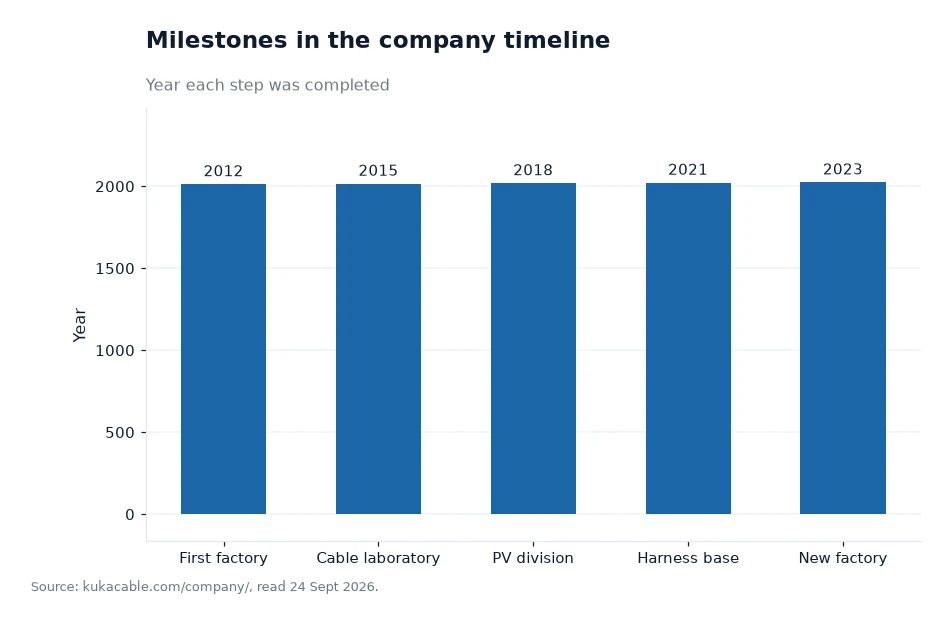
The chart does not describe cable performance, and it should not be read as though it did. It records when the capability behind the eight rows was built: a lab in December 2015, an independent PV division in August 2018, a wire harness processing base in June 2021 and a new factory in May 2023. A manufacturer that has only recently assembled a PV test capability can publish the same eight rows as one that has run them for a decade.
The dates also explain the shape of the range. The company was founded in August 2012 and its first factory was completed in December 2012; by March 2016 it had sold to over 70 countries. Today the customer base is more than 120 countries, and the facility in Jinshan District, Shanghai covers more than 7,000 m². A specifier reading a datasheet can use those dates as a rough check on how long the construction has been in production.
| Row | Published figure | How to verify it |
|---|---|---|
| Conductor | Tinned copper, class 5 to IEC 60228 | Strand count and single-wire diameter on the datasheet |
| Rated voltage | DC 1.8/1.8 kV | Compare with the string voltage and the system design |
| Insulation and sheath | XLPO, electron-beam cross-linked, LSHF | Wall thickness measured on the sample |
| Temperature | −40 °C to +90 °C ambient | Short-circuit limits stated separately on the same page |
| Bending radius | 4 × outer diameter | Measure the outer diameter, then multiply |
| Proof tests | Spark test 10 kV; 6.5 kV AC for 5 minutes | Batch test record issued with the delivery |
Worked example
Use the eight rows to price the risk of a substitution. Take the 6 mm² build: 84 strands of 0.29 mm, an outer diameter of 6.0 mm and a nominal weight of 78 g/m. A different supplier offering a nominally identical 6 mm² cable at a smaller diameter — say 5.6 mm — would be 0.4 mm narrower across the jacket. Over a 1,000 m run that is 400 m of material missing from the outside, before anything is known about the copper inside. That subtraction is mine, from the published 6.0 mm diameter, and it assumes the difference comes out of the jacket rather than the conductor, which a buyer cannot assume without a section photograph.
The eight rows make that check possible in a few minutes. Ask for the datasheet, then for the sample, then measure: strand count and wire diameter, jacket wall, overall diameter and weight per metre. Where a delivered figure differs from the published one, the specification sheet — not the conversation — is the document that settles it.
Frequently asked questions
How many rows should a PV cable specification sheet contain?
Eight cover the load-bearing figures: conductor construction, rated voltage, insulation, sheath, temperature range, bending radius, proof tests and standards. The manufacturer publishes each of these for its 1500 V range, together with a cross-section table that carries the conductor construction, diameter and nominal weight for fifteen sizes.
Does the site publish a warranty or a price for these rows?
No. The pages read for this article publish no warranty terms, no unit price, no minimum order quantity and no lead time. They do publish a service life of 25 years or more, a free sample offer on product pages, downloadable datasheets and certificates, and contact details on every page.
Building the sheet from published figures
Start with the cross-section the design needs, then write the eight rows from the datasheet rather than from memory. Confirm that the conductor row names the IEC 60228 class and the strand pattern, that the voltage row separates the DC rating from the AC proof test, and that the temperature row carries both the ambient range and the short-circuit limits. Add the standards row last, because it is the one an inspector will compare against.
Then collect the documents that sit behind the sheet: the datasheet for the exact model, the batch test record, the certificate copy and the sample. The manufacturer publishes its full range in the solar cable section, the 1500 V details on the 6 mm² product page and the certificate names on the certificates page, along with the company history on the home page. Rows written from those pages can be checked by anyone who reads the same material.
Every row described in this specification-sheet article draws on the manufacturer's own website; the milestone table was downloaded 24 Sept 2026[1].