Checking machinery supplier capabilities means linking the required operating envelope to the supplier’s configuration, production controls, test evidence, available capacity, and after-sales support. Buyers should document what is demonstrated, what remains open, and which conditions must be met before purchase release.
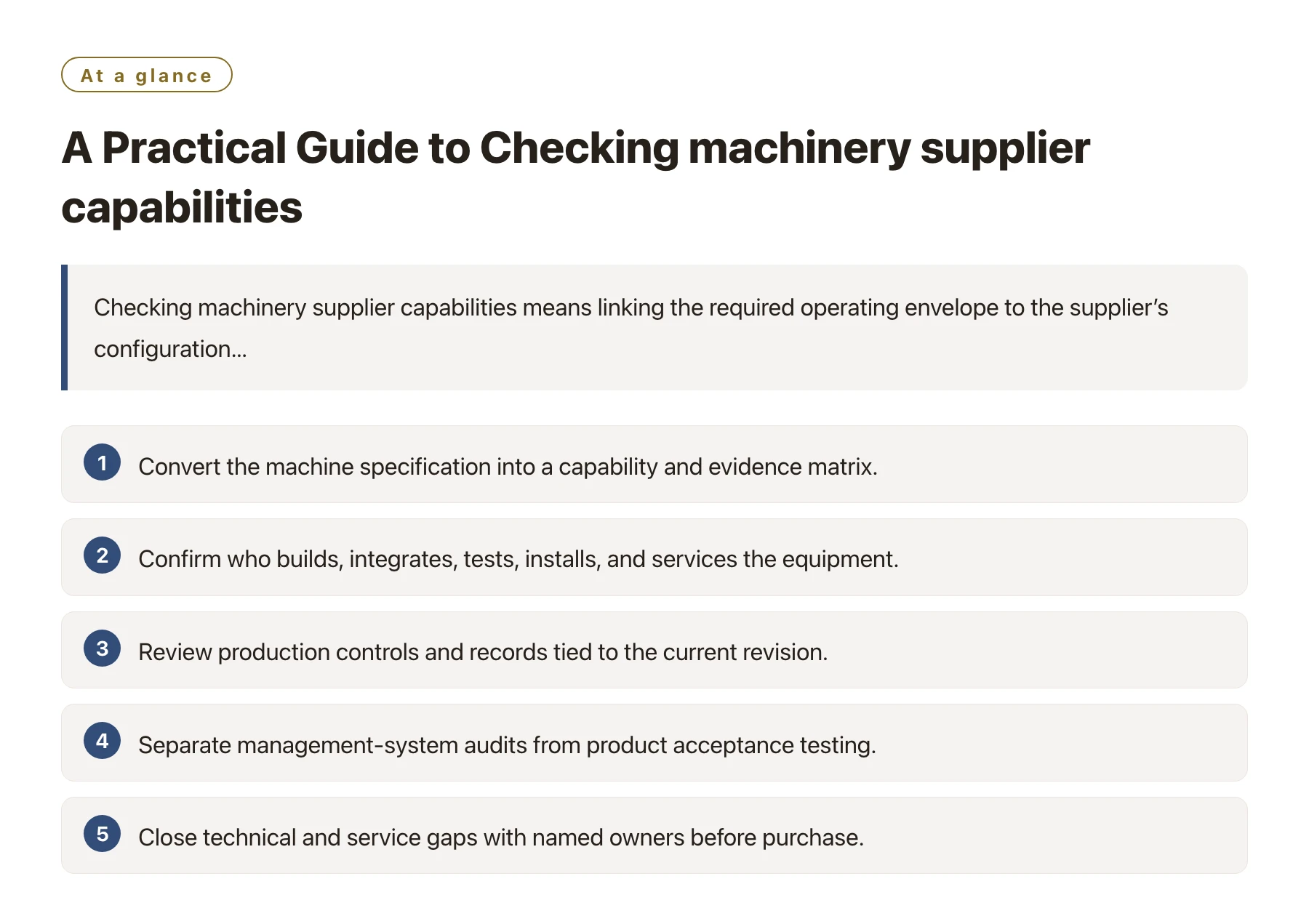
Key takeawaysConvert the machine specification into a capability and evidence matrix. · Confirm who builds, integrates, tests, installs, and services the equipment. · Review production controls and records tied to the current revision. · Separate management-system audits from product acceptance testing. · Close technical and service gaps with named owners before purchase.
A supplier may be experienced in a product category while lacking evidence for a particular machine configuration or delivery window. A structured review helps separate general claims from order-specific capability.
Translate the machine specification into capability questions
Start with the machine’s operating envelope: workpiece materials, dimensions, tolerances, output range, duty cycle, controls, tooling, utilities, and installation conditions. Ask which requirements are demonstrated by the proposed model and which depend on options or buyer-supplied equipment. A product brochure should not be treated as proof that the offered configuration meets the project need.
Create a matrix that links every critical requirement to a capability, evidence source, acceptance method, and owner. Include foundations, floor loading, electrical supply, compressed air, extraction, cooling, guarding, software, data interfaces, and operator training where relevant. Have the engineering owner confirm which site conditions and integration interfaces matter before comparing vendors.
Ask the supplier to identify the exact model, manufacturer, country of manufacture, key subassemblies, and proposed configuration. Confirm whether the quoted entity builds, assembles, integrates, or resells the machine and which party provides warranty, spare parts, and technical service.
Review production and integration capability
For a machine builder or integrator, review how design, fabrication, electrical assembly, programming, installation, and commissioning are controlled. Ask for a process map, design review records, assembly checks, software revision control, and evidence from a comparable project. If important work is subcontracted, identify the subcontractor and how the main supplier verifies it.
Observe whether drawings, bills of materials, work instructions, and inspection records match the current product revision. Check how nonconforming components are identified and how engineering changes reach purchasing, assembly, test, and service teams. Look for traceability of critical parts and configuration records that will travel with the machine.
For a component supplier, focus on relevant operations such as machining, casting, heat treatment, surface finishing, welding, or calibration. Verify process equipment, inspection tools, maintenance status, and personnel competence against the part tolerances and material requirements rather than judging capability from factory size alone.
Confirm quality and test evidence
Ask how the supplier verifies dimensions, performance, safety functions, repeatability, and output under defined operating conditions. Request the test protocol, acceptance limits, calibrated equipment list, sample identity, test date, and unresolved deviations. A factory demonstration should use the agreed material, tooling, software, and operating conditions where possible.
Inspect how the supplier handles failure: containment, root-cause analysis, corrective action, retest, and customer notification. Review records tied to a recent machine or production lot. A blank form shows a template exists; a completed record can show how the process was applied, though it still needs context and verification.
A management system audit should have a defined scope, criteria, competent reviewers, and evidence. ISO 19011:2026 provides guidance on audit principles, program management, conducting audits, and auditor competence. Use it as an audit-planning reference while keeping product acceptance tests and engineering verification distinct.[1]
Assess capacity, maintenance, and service support
Ask what workload and critical resources are already committed during the required delivery window. Review the production plan, long-lead components, assembly space, test capacity, and dependencies on specialist staff. Identify which milestone could delay completion and what evidence will be provided if the plan changes.
Check preventive maintenance and calibration for equipment that affects product conformity. Ask how downtime is reported, whether backup equipment is qualified, and how the supplier preserves records after a process moves. Capacity is useful only if the machine, tooling, operators, and inspection resources are available when the order needs them.
Define service coverage: installation, commissioning, training, manuals, diagnostics, response hours, spare-part codes, and escalation. Confirm which support is remote and which requires travel, and how warranty cases are documented. For an imported machine, plan for language, time zone, software access, and local maintenance capability.
Close gaps before purchase commitment
Summarize findings by requirement: demonstrated, partially demonstrated, not demonstrated, or not applicable. List evidence reviewed, site limitations, open technical questions, and proposed actions. Separate objective observations from conclusions so engineering and procurement can make a transparent decision.
Set qualification conditions before order release, such as a witnessed acceptance test, approved drawing, corrected process record, or confirmation of service parts. Assign each action to a named party with due date and closure evidence. Do not treat a supplier’s general capability statement as a substitute for closing a specific gap.
For industrial equipment sourcing support, buyers can define whether a sourcing partner will research suppliers, collect technical evidence, arrange site access, coordinate a factory review, or support quote comparison. Specify what the provider verifies and what remains an engineering or buyer decision. Retain the capability matrix with the final quotation and purchase record.
Sources
Frequently asked questions
Is a factory tour enough to confirm machinery supplier capability?
No. A tour is one source of evidence. Compare the offered configuration with requirements, test records, process controls, capacity, service resources, and open gaps.
What should a machinery demonstration include?
Agree on machine configuration, material, tooling, software revision, operating conditions, measurements, acceptance limits, and who witnesses and signs the results.
Does a quality management certificate prove a machine will meet the project specification?
No. A system certificate does not replace configuration review, engineering verification, acceptance testing, or evidence for the specific delivered machine.
What service details should be confirmed before ordering?
Confirm installation, commissioning, training, manuals, response route, warranty, software access, spare-part codes, and the availability of qualified maintenance support.